Inside the firm portal
What your bookkeeper sees in the morning.
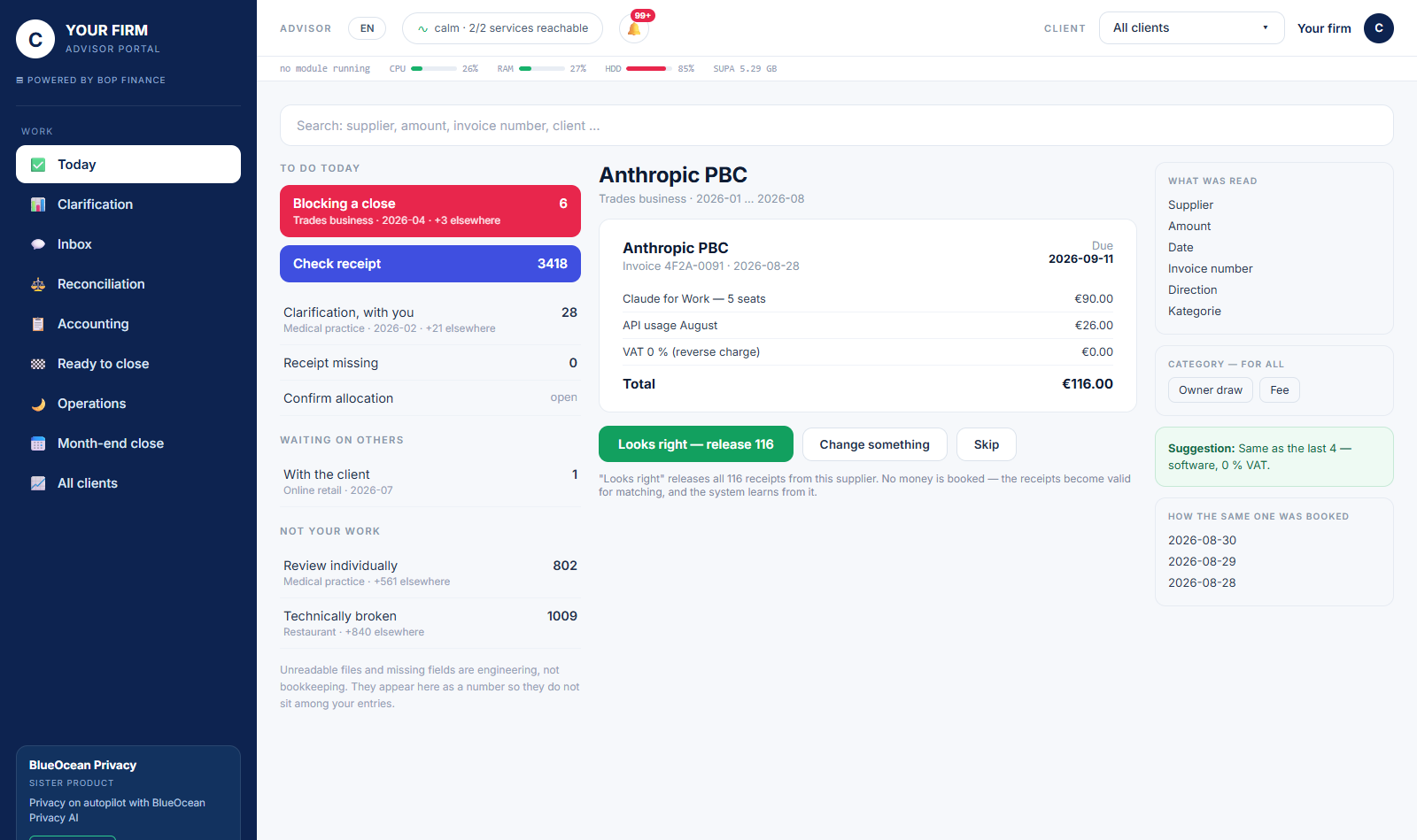
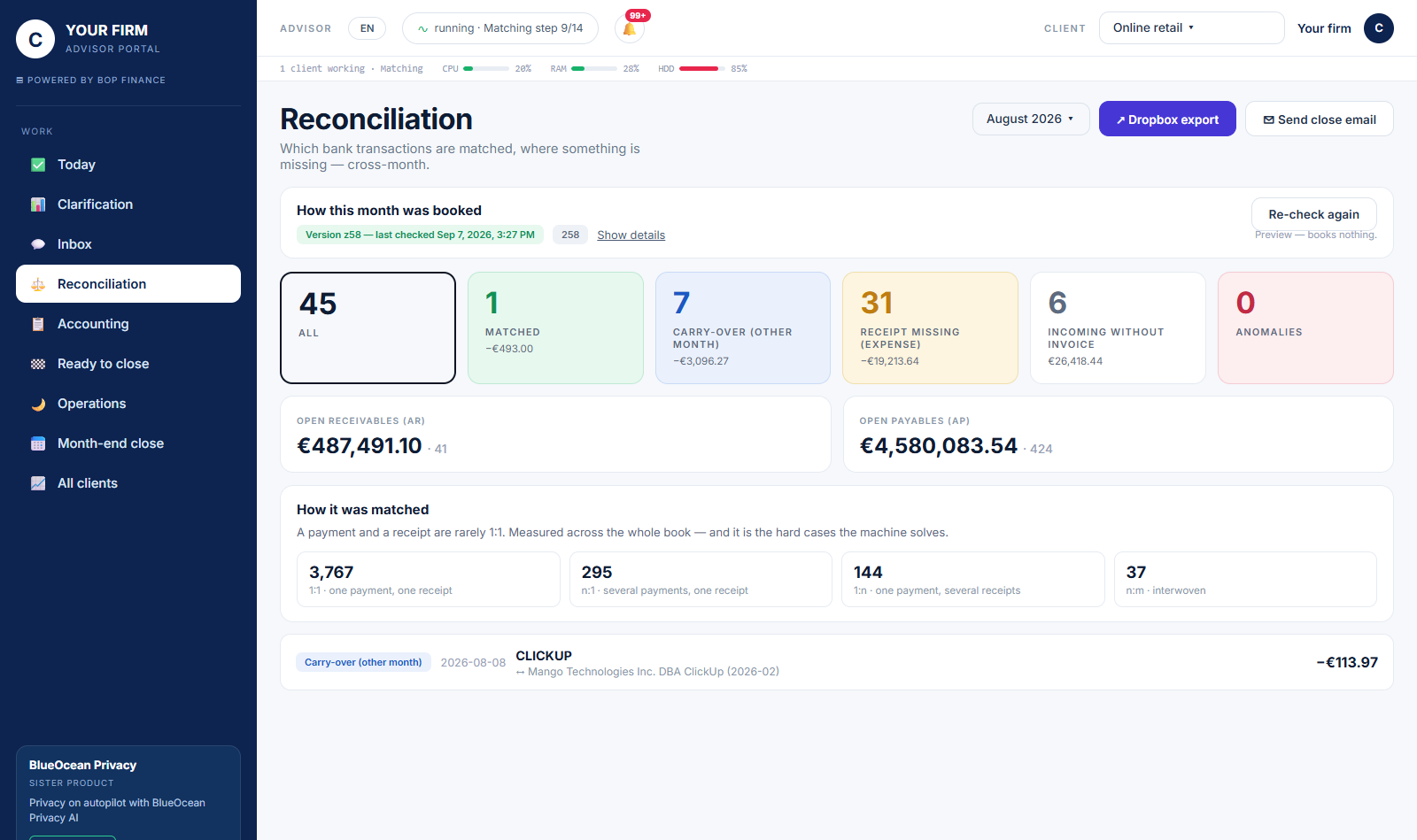
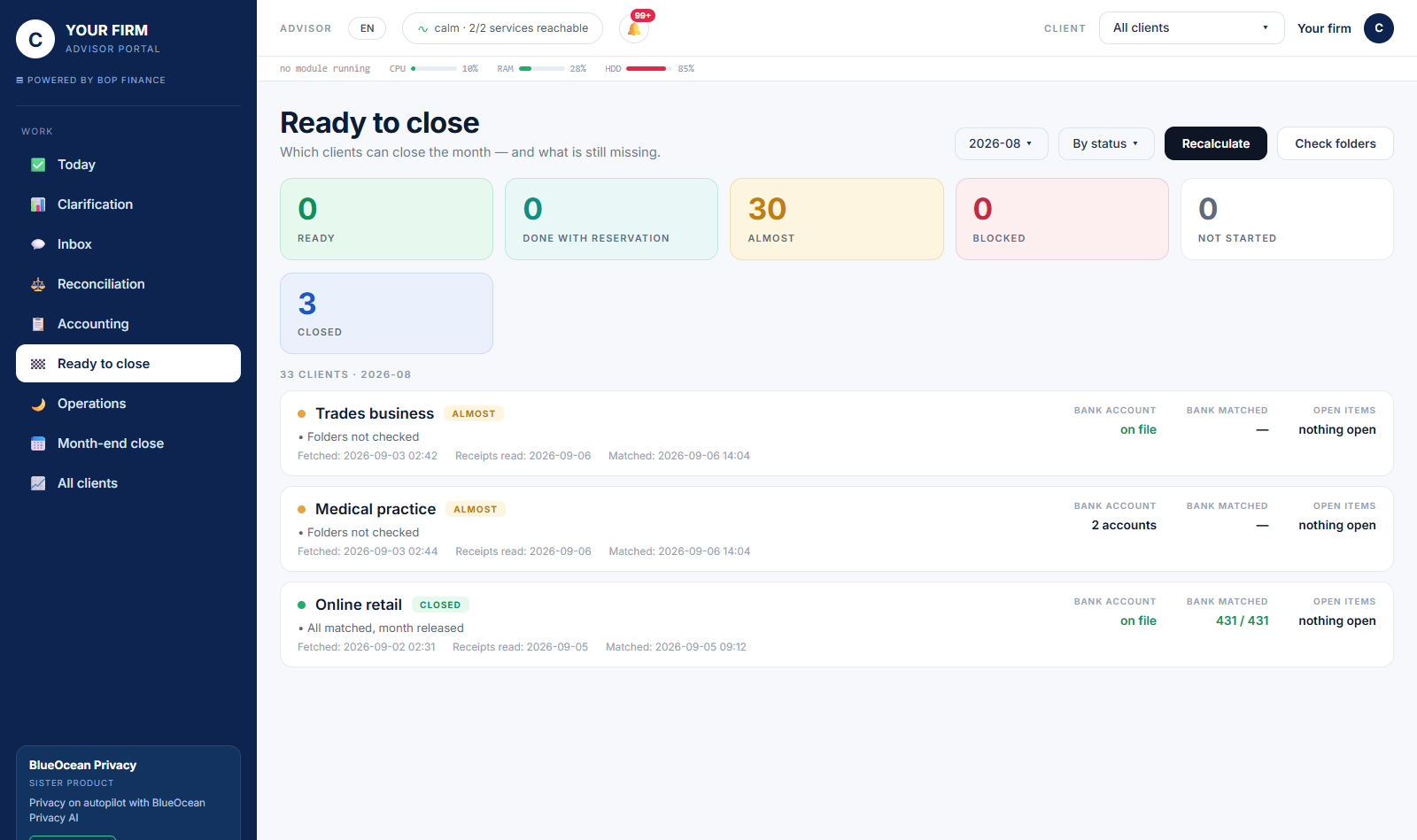
BlueOcean Finance is an AI for tax firms. It collects your clients’ receipts, captures them, imports the bank statement, matches payment to receipt and prepares the month for closing. Whatever it cannot decide with confidence, it puts in front of you.
No pilot, no demo data: 33 clients and three firms work with it. What has come of that so far is below — with the query behind it, in case you want to check the arithmetic.
476 of the allocations are not 1:1 — and the machine solved 472 of them. Precisely the cases that cost manual work: one transfer against three invoices, five prepayments against one monthly invoice, interwoven chains.
Two qualifications we would rather add ourselves: the 99.2 % refer to the allocations, not to all bank lines — 13,794 bank transactions face 4,342 allocations, and what needs no receipt (fees, salaries, owner draws) is not separated out in that figure. And they do not mean nothing is left for your people: in August 86 clarification cases stood open that nobody worked on. What the machine cannot do stays put until a person decides.
Not the total since launch, but a single completed month — so you can see what actually stands there at month end.
Exactly one of the three is responsible, never "somebody". That nothing sat with the client means the system had already done the chasing.
Number of clients affected. None of these is a surprise on the 10th — each one sits on the board from day one.
How many payments stood without a receipt at month end is in the section below — separated by what genuinely needs a receipt and what never gets one. Until 9 September that split was only computed at the moment of the call; since then a nightly run records it. That is why the section below shows a series that grows by itself, not a snapshot.
Every expense of the month sits in exactly one of three buckets — 1,804 expenses across all 33 clients. Not an average of the good months, not a target.
About half is still missing. 763 out of 1,449 expenses that need a receipt are still waiting for one in August. That is the starting point, not the result — anyone promising you 90 per cent has either measured something else or nothing at all.
And the month before was not worse: July 879 out of 1,751 (50.2 %), August 52.7 %. We can forecast where this is heading — but this is today’s state. And when a number looks better, we check first whether something improved — or only the denominator did.
So there is no doubt about what you are seeing: these are our own books — the first reference project, and it is at the beginning. The improvement comes over the next days, weeks and months, cycle by cycle. And it does not come from the model alone: the system gets the most out of it when a bookkeeper teaches it what she knows about the client. We are not dressing anything up here.
A client thought the figure was too high. Re-measured across July and August: all 1,661 lines in the “receipt missing” bucket carried the same reason — “no rule found”. Not one said “a receipt belongs here”.
Held against the document store: for 1,170 of the 1,661 lines (70.4 %) a supplier document is already in the system — it is simply not matched. Only 491 have nothing at all.
So there is no misunderstanding: that is 70 % of the lines, not 70 % of finished bookings — several lines often reach for the same piece of paper. And no receipt turned up. The bucket shrinks because the classification is right, not because paper was found.
The system applied a rule it had learned from the bookkeeper 401 times — and not one of them had to be taken back by a person. For 23 of 33 clients this already happens on its own.
Plus 35 learned supplier names, applied 105 times. 19 of the 35 rules now fire without asking.
This knowledge does not come from the model but from the people who know the client. That is why it gets better month by month — and why a human stays the authority on the professional questions.
A salary payment has no invoice — it has a payroll statement. Rent has a lease. Until now our system did recognise such payments — and then asked for nothing at all. An auditor sees a payment with no paper whatsoever. Since 9 September it says which document is needed instead, and requests it from the client.
Bundled, otherwise it would be hundreds of requests: one payroll statement covers every employee of a month, one lease every month with the same landlord. Across the estate that became 111 requests at 22 clients, together explaining 206 bank lines. Bank fees, cashback, internal transfers and our own fee deliberately owe nothing — a reason that is not on this list produces no request.
The obvious rule “exchange rate = currency swap” would have been an expensive mistake. The phrase appears on 637 bank lines — but only 27 really are a swap. The other 610 are card payments with an invoice. Had the phrase alone made the rule, 610 expenses needing a receipt would have vanished silently.
That is the most dangerous kind of error, because it hides a defect instead of reporting it. Six of those lines are now a counter-check in the test suite — it fails the moment anyone puts the convenient rule back in.
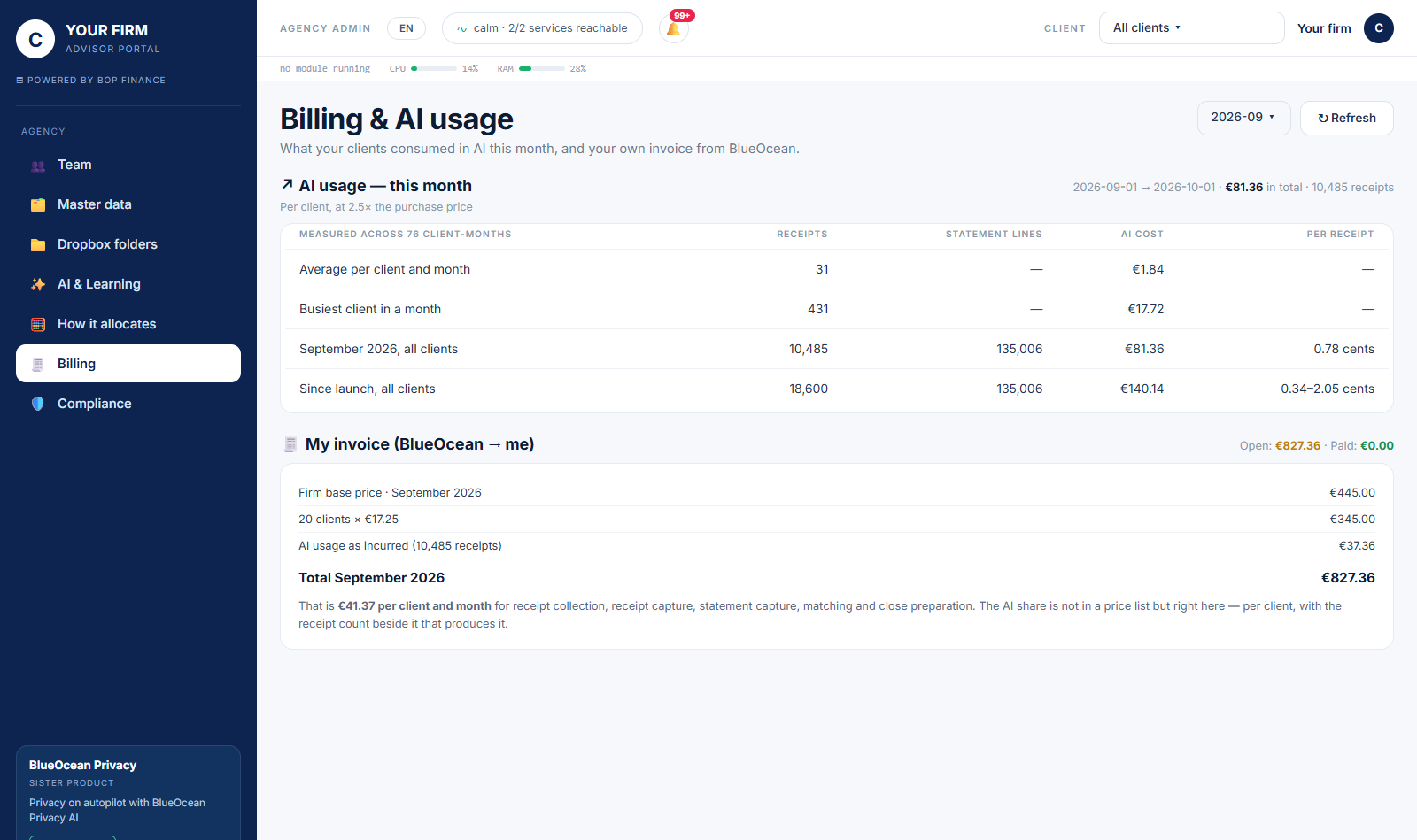
€3.41 per client per month, combined — measured from 33 clients, July and August 2026, extrapolated to 400 clients with a factor of 12.1 (€1,363/month). No second, invented per-client fee: an earlier version of this page cited €17.25 per client, which never existed as a measured figure.
What stands behind the price: our own AI cost runs €0.32 for an average client, €0.85 for a large one (300 receipts, 8 statements, 500 bank lines) — formula: 0.14 cents per receipt, 1.61 cents per bank statement, 0.06 cents per bank line, measured over 44 client-months in July and August 2026. An earlier version said €0.11 to €0.77 here; it counted only the receipt reading and left out statement and reconciliation.
| Profile | Receipts | Statements | Bank lines | AI cost/month |
|---|---|---|---|---|
| Average — measured | 59 | 4.4 | 110 | €0.32 |
| Large — worked example | 300 | 8 | 500 | €0.85 |
| Very large — worked example | 500 | 16 | 900 | €1.50 |
| Extremely large — worked example | 900 | 25 | 1,400 | €2.50 |
Only the first row is measured. The other three are the same formula, extrapolated further, with round input numbers — not a case we have actually seen with you. A really complex client (several accounts, many statements) can end up above the average usage share in the price; the base price (€2.50) stays the same either way.
And one figure you will not find here: hours saved. We have no measurement for that, so we do not claim it. What we have measured are receipts, cost and the share of machine-made allocations.
We set up your folders, re-run a month you have already closed, and show you what the system would have found on its own. You see the result before you decide.
Book a call — 45 minutes on your numbers
€150 for 45 minutes. Credited in full once it turns into a project or a feasibility study.
Prefer to write? info@blueoceanfinance.ai